Ghent or Bruges: Which Matters to You?
What Bruges does perfectly: the preserved fairytale
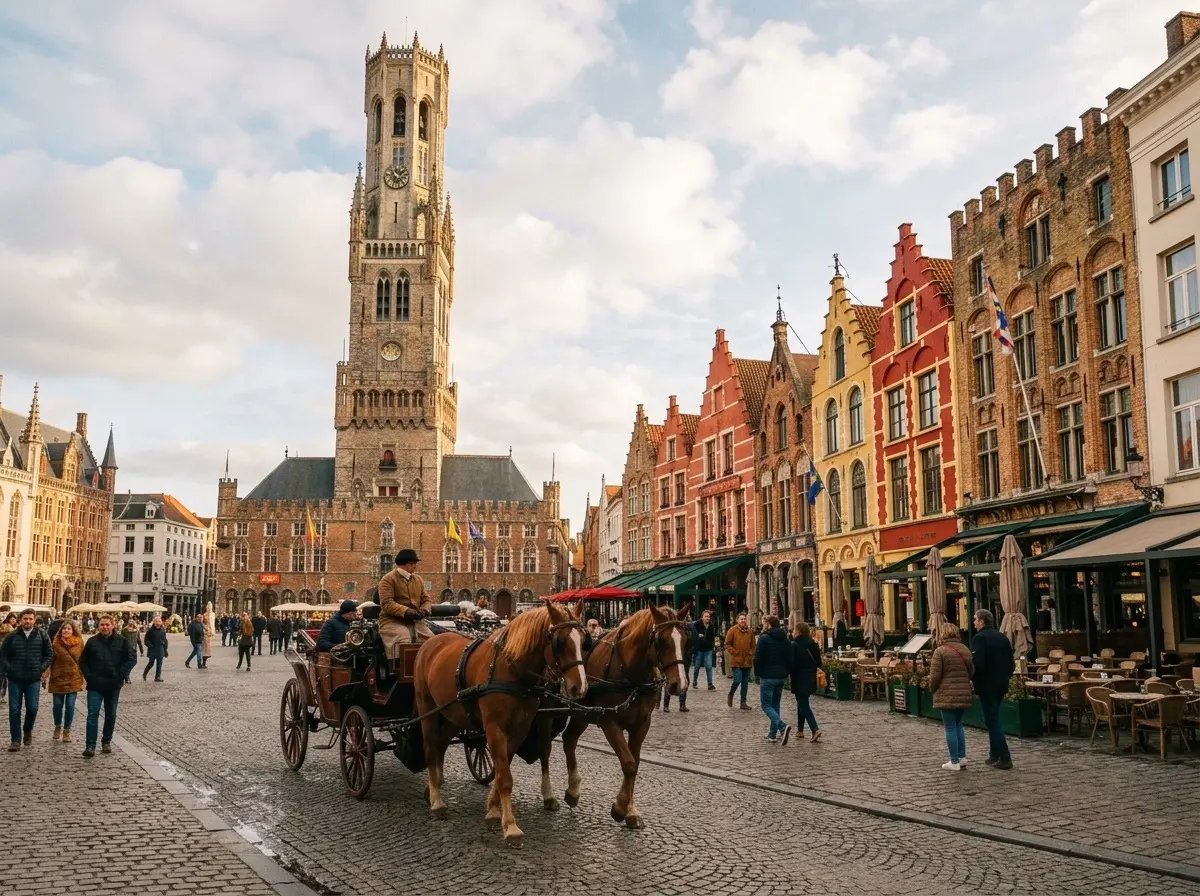
Bruges (Brugge) is the postcard medieval town: swans on canals, lace shops, beguinage courtyards, perfectly maintained guild halls. No traffic noise in the centre (car-free since 2002). It’s beautiful, compact (1.5 km core), easy to walk. Tourist infrastructure is excellent: guided walks, restaurants at every corner, gelato everywhere. A day trip from Brussels, Amsterdam, or the coast is standard.
Why people love Bruges: it feels untouched. The Belfry, St John’s Hospital (museum of medieval medicine), the Markt square — all look like paintings. Photography is easy here; Instagram shots compose themselves. You can rent a rowboat and float under stone bridges. The Christmas market (November–December) is among the best in Europe. It’s a complete fantasy landscape and it works for that reason.
Drawback: Bruges is drowning in tourists. Peak season (May–September) sees 10,000+ day-trippers daily. Restaurants on the Markt charge EUR 25–35 for pasta that would cost EUR 12 in a local neighbourhood. The Beguinage is lovely but roped-off and choreographed for photos. You’re never truly alone; you’re always in someone’s Instagram frame.
What Ghent does differently (and why that matters)
Ghent (Gent) has the same medieval monuments as Bruges — Gravensteen castle, St Bavo’s cathedral, a Belfry, canal-side guildhalls on the Graslei. But Ghent feels inhabited. You’ll see 40,000 university students on bikes, graffiti murals (intentional street art), independent bars and restaurants, a working medieval city overlaid with contemporary life.
Ghent also has grit. The medieval alleyways of Patershol host proper restaurants, not tourist pasta joints. Waterzooi (a Flemish vegetable stew with chicken or beef) is the signature dish, EUR 14–18, served in small family-run spots that have been there 30 years. Walk the quiet lanes at 15:00, and you’ll see locals buying groceries, children playing, elderly couples sitting in cafes. Not tour groups, not Instagram setups, just life.
The Ghent atmosphere changes at dusk. The Graslei (guild halls on the water) is medieval by day but comes alive at 18:00 when locals and visitors sit with beer and wine, watching the light change on the stonework. This is the Ghent moment: not museum-perfect, just perfect. You can sit there for an hour and not take a single photo.
Itinerary implications: time and logistics
One day in Bruges: Markt square (arrival, 30 min), Belfry climb (45 min), St Saviour’s Cathedral (20 min), Beguinage (30 min), canal tour (1 hour). You see the postcard views. Evening walk on the water. Works if you arrive morning.
One day in Ghent: Gravensteen, canal cruise, Patershol lunch, St Bavo’s, Belfry, Graslei at dusk. More relaxed pace because the core is walkable and less congested. You have time to sit and absorb rather than photograph and move.
Two days in Bruges: Markt, Belfry, St Saviour’s, Beguinage day 1. Day 2: museums (Groeningemuseum, Church of Our Lady, Memling Museum, around EUR 30 total). Feels adequate but honestly, the magic is Bruges-as-backdrop. After two days, you’ve seen everything worth seeing.
Two days in Ghent: Core monuments day 1 (same as one-day itinerary), museums and neighbourhoods day 2. More breathing room, time to eat well twice, time to sit in Patershol twice, time to know the place rather than just see it.
The practical comparison
Usually included
- Size: Bruges ~118,000 people, Ghent ~250,000. Bruges feels small and contained; Ghent is bigger but medieval core is still walkable.
- Tourism pressure: Bruges rammed with day-trippers (peak 10,000+ per day, roughly 3 million annually). Ghent is busy but locals still outnumber tourists on quiet streets.
- Food scene: Bruges: tourist-facing (waffles EUR 5–8, tourist-trap pasta EUR 25–35). Ghent: local-first (waterzooi EUR 14–18, Michelin restaurants EUR 40–70, no tourist padding).
- Hotels and food cost: Bruges 3-star EUR 120–160/night, tourist meal EUR 20–30. Ghent 3-star EUR 90–130, local meal EUR 14–25. Ghent 20–30% cheaper.
- Paid attractions: Bruges 15+ museums (Belfry, Church of Our Lady, Memling, Groeninge). Ghent 5–6 major sites (Gravensteen, Belfry, St Bavo’s, Citadelpark museums).
- Free attractions: Both have free walking routes, free cathedral grounds, free squares. Both offer free observation of daily life.
- Peak season timing: Bruges: any time is busy, May–September is rammed. Ghent: quieter year-round, Gentse Feesten (10-day music festival in July) brings organised chaos but locals still participate.
Doing both cities in one trip
The real answer: do both. Train between them is 30 min (EUR 9 return, every 15–20 min). Sample itinerary:
Day 1 in Bruges: Arrive 08:30 via early train. Walk Markt square (30 min), climb the Belfry if energy permits (45 min), visit St Saviour’s Cathedral (20 min), wander the Beguinage or a quiet canal neighbourhood (60 min), canal evening boat ride at 16:00 (50 min). Dinner near the Markt or on a quieter street. Train to Ghent 18:50 or 19:20 (30 min). Sleep in Ghent.
Day 2 in Ghent: Start with the one-day itinerary (Gravensteen, canal, Patershol lunch, St Bavo’s, Belfry, Graslei sunset). Or stay 2+ nights in Ghent for more breathing room.
That’s two full cities in two days, train-connected, no car stress.
Combining both with Brussels
If starting from Brussels, consider: Day 1 Brussels (Grand Place, museums), Day 2 Ghent (core itinerary), Day 3 Bruges (or vice versa). All three are on the same IC train line: Brussels to Ghent (40 min), Ghent to Bruges (30 min). Total loop is 1.5 hours of train. Trains every 15–20 min.
The honest choice
Choose Bruges alone if: you want postcard perfection, have only one day, prioritise photography over atmosphere, don’t mind crowds, and love chocolate/lace shops. Bruges is uncompromising about being beautiful.
Choose Ghent alone if: you want atmosphere over beauty, prefer real food and beer culture, like time to wander aimlessly, and get irritated by tourist infrastructure. Ghent rewards slowing down.
Choose both if: you have 2+ days. Each city deserves a full day. They’re 30 minutes apart and the train ride is scenic. You’ll understand Flanders better for having seen both extremes.
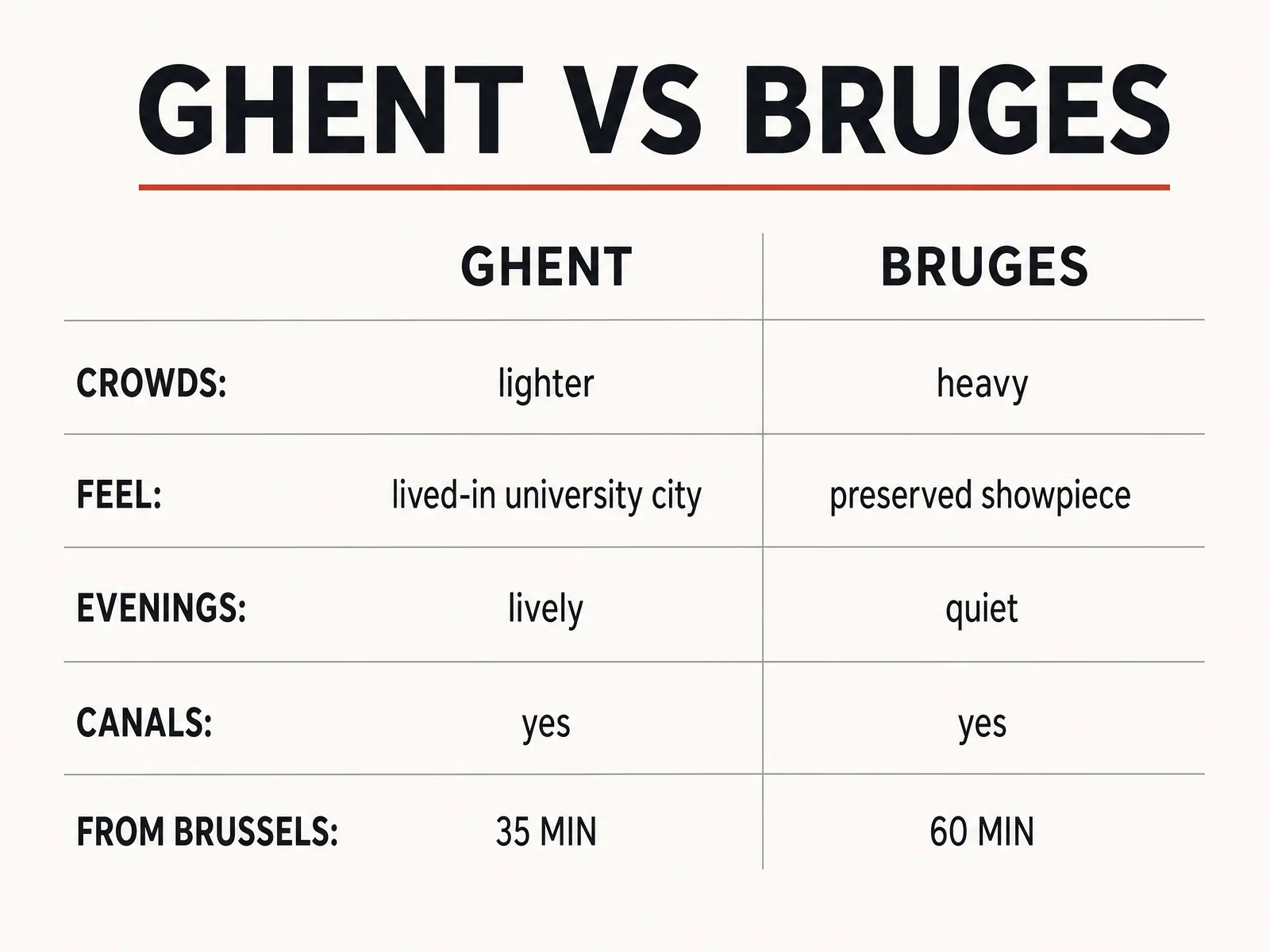
Bruges: fairytale photos, swans, chocolate, crowds. Ghent: atmosphere, locals, waterzooi, quiet streets. They’re 30 minutes apart by train. Pick one for time pressure, do both for depth.
From Brussels: Bruges & Ghent Day Tour
Coach day trip covering both cities, 6–7 hours, local guide, optional meals. Logistics handled, perfect if you’re not renting a car.
Check ticketsFrequently asked questions
Is Ghent better than Bruges?
No. Different. Bruges is fairytale-perfect; Ghent is lived-in and atmospheric. Bruges for beauty, Ghent for soul. Both are medieval, 30 min by train.
Can I do both in one day?
Theoretically yes (book a day-trip coach tour), but rushed. Better: 1 day Bruges, 1 day Ghent. Or 1 day either if choosing one.
Which has better food?
Ghent. Waterzooi, Patershol restaurants, local brewery culture. Bruges = tourist prices, waffles, chocolate. Ghent = real Flemish food, EUR 14–25.
Which is more crowded?
Bruges by far. Peak season: 10,000 day-trippers. Ghent is busy but locals still outnumber tourists on quiet streets.
Which do first-timers prefer?
First-timers usually pick Bruges for the postcard factor. Repeat visitors prefer Ghent for the atmosphere. You need 2+ days in Belgium to appreciate both.