Brussels to Ghent (2026)
Brussels to Ghent by IC train — 32–40 min journey, every ~10 min.
Train journey: Brussels Central to Gent Sint-Pieters
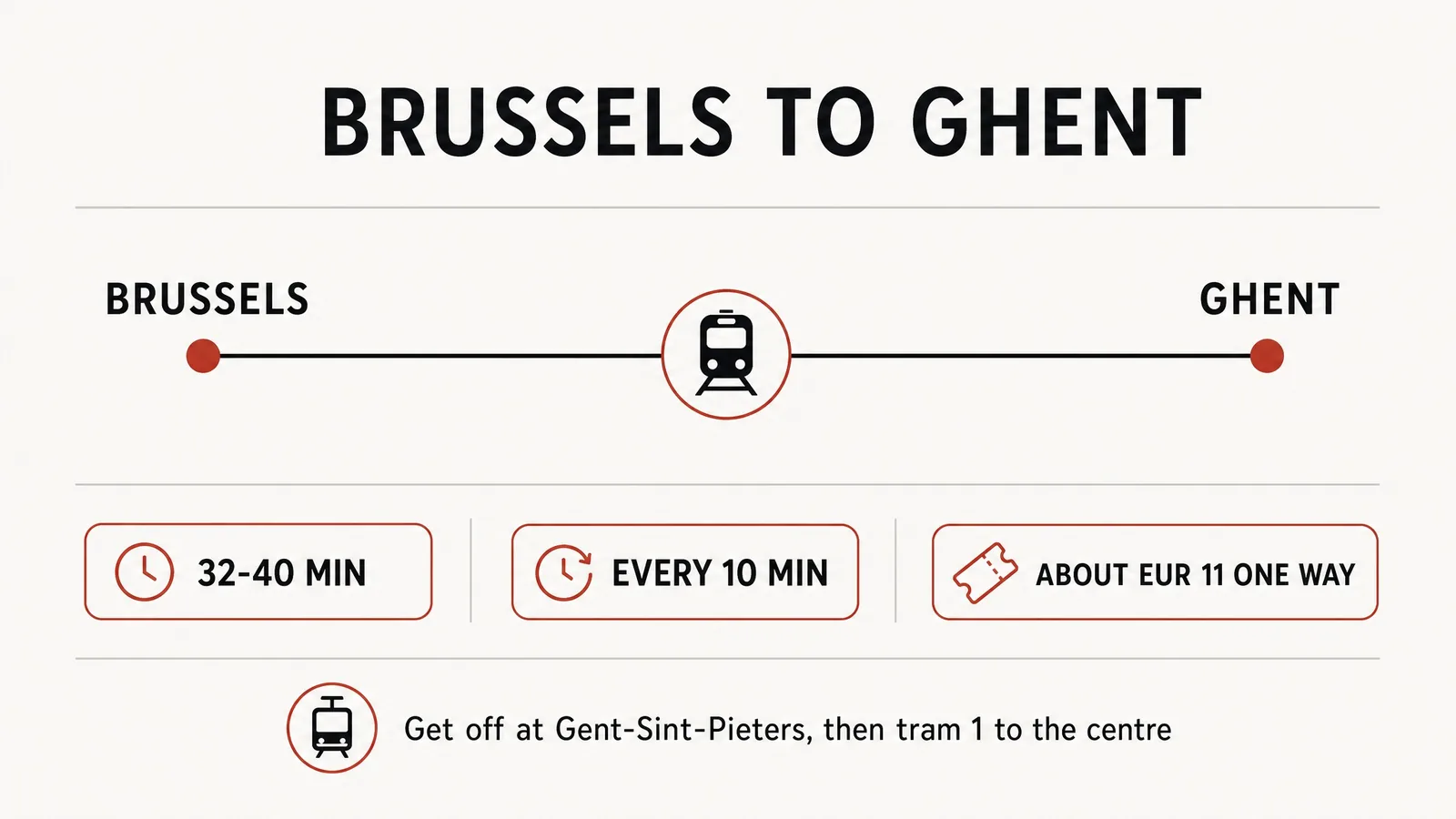
The IC train from Brussels to Ghent is the default route for most travellers. Trains depart from Brussels Central station (Bruxelles-Centraal) or Brussels-South/Midi (Bruxelles-Midi) roughly every 8–12 minutes during peak hours (06:00–22:00), fewer trains on Sunday evenings. Journey time is 32–40 minutes depending on whether the train stops at intermediate stations like Brussels-Nord or Louvain. All trains arrive at Gent Sint-Pieters, south of the medieval core.
Ticket types and fares
One-way standard ticket: around EUR 11 (peak hour, no discount). Saver fares (Premïa ticket or off-peak booking): EUR 7–9 if purchased in advance online via belgiantrain.be or the SNCB app. Children (4–11) travel at 50% fare; under 4 travel free if they sit on a lap. Day-return tickets are around EUR 20 (buy one ticket in each direction for same price as return). Weekend and youth fares exist but are modest discounts (around 10%).
Book on belgiantrain.be 1–7 days ahead for best saver pricing. Last-minute tickets at the station kiosk cost full price (EUR 11). The SNCB app shows real-time availability.
Which Brussels station: Central or Midi?
Both offer frequent connections to Ghent. Brussels Central (Bruxelles-Centraal) is in the city centre, near the Grand Place and museums. Brussels-Midi (Bruxelles-Midi/Brussel-Zuid) is where most international trains arrive (from Paris, Amsterdam, Cologne). From Brussels Airport, take the airport train to either station (15 min, EUR 9), then continue to Ghent. If staying in Brussels city centre, Central is more convenient. If arriving by coach or international train, Midi is your arrival point.
Luggage, bicycles, and seat reservations
Luggage: IC trains have overhead racks and under-seat space. One carry-on + one small bag are free. Large suitcases are common and don’t require booking. Bicycles: EUR 10 one-way, must be folded or in a bike bag on most IC trains; check belgiantrain.be when booking. Seat reservations are optional (not required) and cost EUR 2–5 extra; unreserved seats are plentiful except peak Friday/Sunday evenings.
Once you arrive: Gent Sint-Pieters station to the medieval centre
Gent Sint-Pieters is south of the medieval core — the Gravensteen, Belfry, and Graslei are all north. Three options to get there:
Option 1: Tram 1 (fastest, EUR 2.50). Exit the station forecourt and look for the tram stop marked with a blue “1”. The tram runs north through the city. Ride it toward Sint-Jacobs or Graffiti Street; either stop puts you in the historic core in about 10 minutes. A single ticket costs EUR 2.50; if you buy a De Lijn day pass (EUR 8, covers all trams and buses), it’s better value if you plan multiple trips. Trams run every 5–10 minutes, all day.Option 2: Walk (25–30 minutes). Head north from the station on Sint-Pietersnieuwstraat. The route is straightforward and passes through quiet residential neighbourhoods. At the Citadelpark (old fortification grounds, now green space), bear northeast toward the towers. It’s a pleasant walk if you have time and luggage isn’t heavy.
Option 3: Taxi or Bolt (EUR 12–18). If you have luggage or are tired from your journey, grab a taxi rank outside the station or book Bolt (the local ride-share app) via smartphone. Door-to-door service to your hotel takes 5–10 minutes depending on traffic.
First-timers usually take the tram (fast, cheap, drops you in the core).
Orientation at Gent Sint-Pieters: which exit?
The station has multiple exits. If heading to the tram, follow signs to “Tram 1” or look for the tram shelter in the forecourt. If walking north, exit onto Sint-Pietersnieuwstraat (the main avenue). If booking a taxi, head to the taxi rank outside the main entrance. The station is orderly; you won’t get lost.
From Brussels Airport to Ghent (if flying in)
Brussels Airport (Zaventem) is 15 km northeast of Brussels city centre. To reach Ghent from the airport: (1) Take the airport train (Diabolo line or Brussels Airport Express) to Brussels Central or Brussels-Midi (15 min, EUR 9). (2) Change to the IC train to Gent Sint-Pieters (40 min, EUR 11). Total journey ~1 hour, total cost ~EUR 20. Trains run every 15–20 minutes; no booking needed for the airport connection. This is the cheapest and most reliable option.
Alternatively: pre-book a shuttle bus from the airport to Brussels Central (around EUR 20, slower) or rent a car and drive direct to Ghent (1.5 hours, 60 km via E19). Train is usually fastest.
Driving: Brussels to Ghent via LEZ and circulation plan
Brussels has a Low Emission Zone (LEZ) covering the city centre. Cars not meeting Euro 4 emission standards are fined EUR 350 on entry. Rental car companies must certify compliance. Ghent also enforces a circulation plan (restricted traffic zones, one-way systems, camera-monitored fines of EUR 100+). Driving through both cities is expensive, stressful, and unnecessary.
If you must drive: rent at Brussels Airport, drive direct to Ghent via the E19 highway (1.5 hours, 60 km, tolls apply), and park in a paid garage south of the medieval core (typical EUR 2/hour, EUR 15/day). Ghent’s medieval centre is car-free after 10:00 weekdays and all day Sunday.
Better option: drive to Gent Sint-Pieters station parking (EUR 5–10/day), then tram or walk to your hotel.
Guided day-trip alternative: skip logistics entirely
From Brussels: Guided Day Trip to Bruges and Ghent
Escorted coach tour departing Brussels 08:00–09:00, returning ~18:00. Includes guide, walking tour of both cities, lunch stop optional. No logistics, no navigation needed.
Check ticketsBrussels & Ghent: Guided Train Day Trip
Smaller group, train transport, 3-hour Ghent walking tour. More intimate than coach, pick your own lunch spots, includes station pick-up from Brussels central area hotels.
Check ticketsGuided tours are worthwhile if you hate logistics, prefer a local’s perspective, or want to skip navigation. Coach tours are sociable; train-based tours are more flexible. Both include a Ghent walking guide and leave from central Brussels hotels.
Timing your visit: best days and hours
Weekdays (Tuesday–Thursday mornings) are quietest in Ghent. Weekends and Friday fill with day-trippers from Brussels, Amsterdam, and the Dutch coast. Peak hours in Ghent are Saturday 11:00–17:00 and Sunday 10:00–16:00. If visiting on a weekend, take an early train (08:00–09:00) to arrive by 09:00–09:40, or stay overnight to avoid the rush back to Brussels on Sunday evening trains (crowded and tense).
July (Gentse Feesten festival, 10 days) is packed. August is quieter. December is Christmas markets and holiday crowds.
Day-trip budget and timing
Train: EUR 20 return (EUR 11 each way, or EUR 7–9 saver fares if booked ahead). Food: EUR 30–40 mid-range (waterzooi EUR 14–18, beer EUR 3–5, coffee EUR 2–3). Sightseeing: EUR 20–30 (Gravensteen EUR 13, canal cruise EUR 13, St Bavo’s EUR 6, Belfry EUR 8; pick 2–3). Typical day-trip cost: EUR 70–90 mid-range. If staying overnight: hostel EUR 25–50, mid-range hotel EUR 80–150.
Day trip sample: Brussels 09:00–Ghent 10:00, return 20:00
Arrive Ghent 10:00 via 09:20 IC train. Walk to Gravensteen (15 min), enter and rampart-climb (45 min). Canal cruise (11:00–12:00, book in advance or walk-up EUR 13). Waterzooi lunch in Patershol (12:30–14:00). St Bavo’s Cathedral (14:00–14:45). Graslei golden hour (16:00–17:30). Train back to Brussels 17:50 or 18:20 (arrives 18:30–19:00). A full 9-hour day, comfortable pace, no rushing.
Combinations: Ghent + Bruges
Ghent and Bruges are 30 minutes by train apart. Doing both in one day is possible (especially on a coach tour) but rushed. Better: Day 1 Brussels + Ghent (09:00–18:00), stay overnight in Ghent, Day 2 Ghent + Bruges (morning Ghent museums, train to Bruges 13:00, 4–5 hours in Bruges, train back 18:00–19:00). That’s two full cities in two days without speed-running.
Train from Brussels beats car every time: no LEZ fines, no parking stress, no navigation. Book saver fares 3–7 days ahead on belgiantrain.be. If you hate logistics, book a guided day-trip coach tour; it picks up from your Brussels hotel and handles everything.
Frequently asked questions
How long is the train from Brussels to Ghent?
32–40 minutes. Trains run every 8–12 minutes. One-way ticket around EUR 11; day-trip return EUR 20.
Where does the train arrive in Ghent?
Gent Sint-Pieters station, south of the medieval centre. Take tram 1 (10 min, EUR 2.50) or walk (25 min) to the core.
Can I drive from Brussels to Ghent?
Technically yes, but both cities have strict traffic restrictions (LEZ in Brussels, circulation plan in Ghent). Train is far cheaper and simpler.
Is Ghent worth a day trip from Brussels?
Yes. Ghent is 40 min by train. Half-day visit: canal cruise + Gravensteen + Graslei. Full day: add Patershol, museums, Citadelpark.
What if I fly into Brussels but want Ghent?
Train: airport train to Brussels Central (15 min, EUR 9), then IC to Ghent (40 min, EUR 11). Total ~1 hour, EUR 20. Fastest and cheapest route.